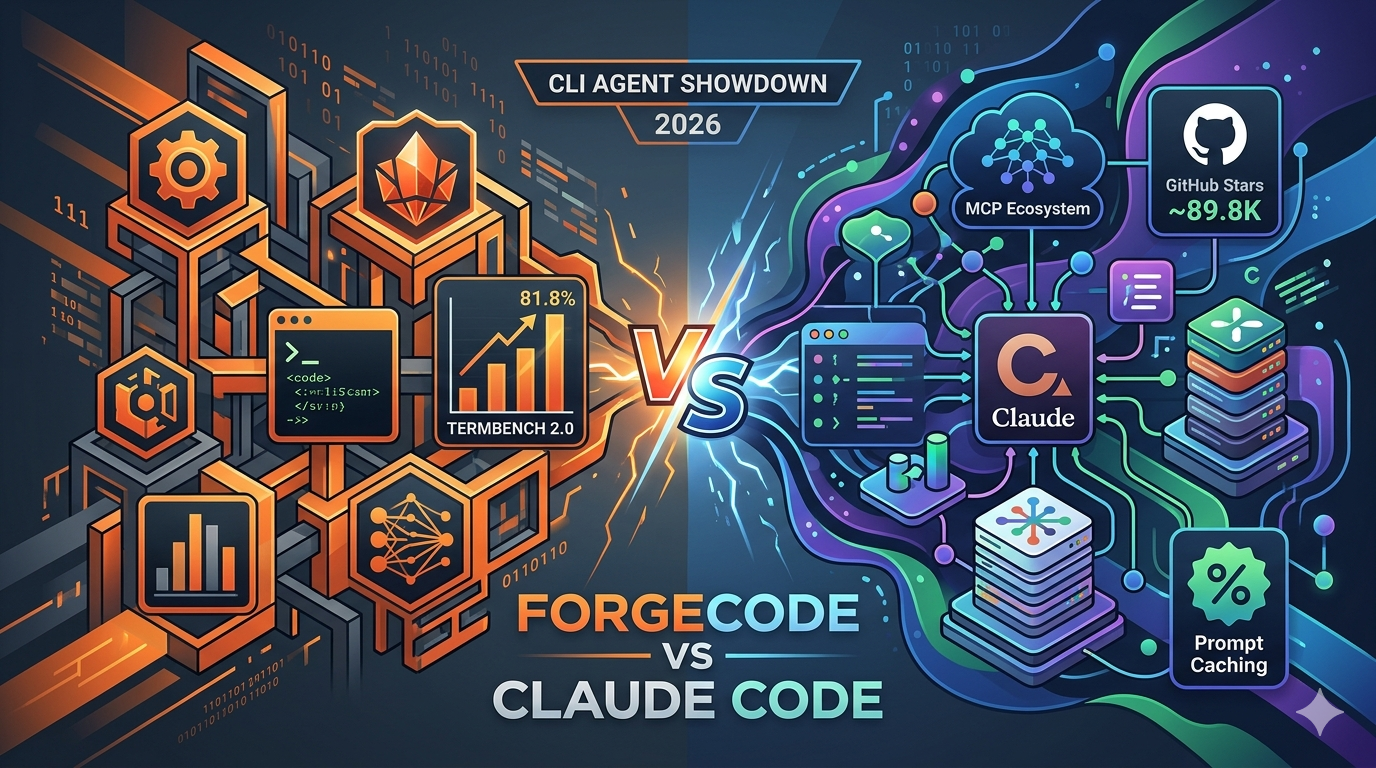

Your terminal is now a battleground. Two agentic coding CLIs want to own it, and they represent fundamentally different philosophies about how AI should write your code. ForgeCode, the open-source Rust upstart, just posted 81.8% on TermBench 2.0. Claude Code, the ecosystem heavyweight with nearly 90K GitHub stars, sits at 58%.1
That gap is enormous. But the benchmark number alone doesn’t tell you which tool to actually use. Let me break down what does.
How Does ForgeCode Beat Claude Code on Benchmarks by 24 Points?
Think of ForgeCode’s architecture like a well-run kitchen brigade. The head chef (the main agent) doesn’t chop onions. She plans the menu, delegates the prep to specialized stations, and only steps in when something complex requires her attention. Claude Code, by contrast, operates more like a single talented cook who does everything herself, from chopping to plating, in one continuous flow. That cook is brilliant, but she burns through energy (context) fast.
ForgeCode’s secret isn’t a better model. It’s a better harness. The team identified seven specific failure modes and built runtime-level fixes for each one:
| Intervention | What It Fixed | Pass Rate |
|---|---|---|
| Baseline (interactive mode) | No enforcement | ~25% |
| Non-interactive + tool-call naming | Unreliable tool dispatch | ~38% |
todo_write enforcement | Agents forgetting their own plan | 66% |
| Subagent parallelization + progressive thinking | Wasted context on trivial tasks | 78.4% |
| Schema flattening + verification enforcement | Model-specific quirks (GPT-5.4, Opus 4.6) | 81.8% |
The critical insight: none of these fixes are model-specific. They operate below the model, at the runtime layer. ForgeCode enforces planning discipline the way a linter enforces code style. The agent doesn’t choose to update its task list; the runtime asserts it. Progressive thinking budgets burn heavy reasoning tokens in the first 10 messages (planning phase), then drop to low thinking for execution. Subagents handle parallelizable grunt work like file reads and pattern searches so the main agent’s context stays lean.
This is runtime engineering, not scale. A team of three built the #1 result on TermBench 2.0.2
Why Does Claude Code Still Dominate Real-World Adoption?
Because benchmarks measure task completion in sandboxes. Your day job happens in a messy ecosystem of GitHub PRs, Slack threads, Sentry alerts, and CI pipelines. Claude Code owns that layer.
Here’s the ecosystem gap in raw numbers:
| Metric | Claude Code | ForgeCode |
|---|---|---|
| GitHub Stars | ~89.8K | Growing, but much smaller |
| MCP Ecosystem | 300+ integrations, 8M+ downloads | Early-stage |
| Native CI/CD | GitHub Actions, GitLab CI/CD | Manual setup |
| Model Options | Haiku / Sonnet / Opus (cost tiering) | Any provider (model-agnostic) |
| Prompt Caching | Automatic, 90% cost reduction on reads | N/A (handled by provider) |
| Auto-compaction | Built-in context summarization | Manual context management |
Claude Code’s prompt caching is particularly clever. Every user running the same version shares a cached system prompt prefix, so Anthropic computes it once. Cache reads cost 3.00/M for fresh input. That’s a 90% discount that kicks in automatically. The economics of the product literally depend on it.3
Auto-compaction solves context window pressure by summarizing earlier conversation turns, preserving the cache prefix while freeing up token budget. If you’ve ever watched an agent degrade mid-session because it ran out of context, you know this matters.
The MCP ecosystem is the real moat. Connect Claude Code to Linear, Notion, Google Drive, Sentry, your internal APIs, or any of hundreds of community-built servers. ForgeCode supports MCP as a protocol, but the sheer volume of ready-made integrations tilts heavily toward Claude Code’s side.
What Are the Pain Points With Claude Code?
Two words: permission fatigue.
Claude Code runs on a permission-based model. By default, it’s read-only and asks before every write, every bash command, every MCP tool call. Anthropic’s own engineering blog admits the problem: “after the tenth approval, you’re not really reviewing anymore. You’re just clicking through.” They report that sandboxing reduces permission prompts by 84%, but the base experience still annoys power users.45
Rate limits are the other friction point. Claude Code enforces a dual-layer usage framework: a five-hour rolling window for burst control and a seven-day weekly ceiling for total compute. Teams report scheduling coding sessions around reset cycles just to ensure quota availability. That’s operational overhead that shouldn’t exist.6
ForgeCode sidesteps both problems. It’s model-agnostic, so you bring your own API keys and manage your own rate limits. No approval fatigue because the runtime design trusts its own constraint enforcement rather than prompting the human repeatedly.
Which Tool Should You Pick for React/Next.js and Django Projects?
For a stack like React/Next.js on the frontend with Django on the backend, the answer comes down to where you are in 2026:
Choose Claude Code if:
- You need CI/CD integration with GitHub Actions or GitLab today
- Your team relies on MCP-connected tools (Sentry, Linear, Slack bots triaging bugs into PRs)
- You want automatic cost optimization via prompt caching and model tiering (Haiku for tests, Opus for architecture)
- You’re already inside the Anthropic ecosystem
Choose ForgeCode if:
- You want vendor neutrality and the ability to swap between OpenAI, Anthropic, Google, or on-prem models per task
- Benchmark-grade task completion matters more than ecosystem breadth (CI agents, autonomous batch processing)
- You’re a small team that values runtime engineering control over plug-and-play integrations
- You want to avoid rate-limit politics entirely
For most teams shipping production React/Django apps right now, Claude Code is the pragmatic choice. The ecosystem integration saves hours per week. But watch ForgeCode closely. Their ForgeCode Services layer, which includes semantic entry-point discovery, dynamic skill loading, tool-call correction, and automated reasoning budgets, represents the kind of runtime-first thinking that eventually wins in distributed systems.2
The Architecture That Matters Isn’t the Model
Here’s the thing the benchmark delta reveals: the gap between a 58% agent and an 81.8% agent isn’t a smarter model. It’s smarter scaffolding. ForgeCode proved that with the same models (Claude Opus 4.6, GPT-5.4), disciplined runtime constraints beat raw intelligence.1
This mirrors a pattern we’ve seen across distributed systems for decades. The best database isn’t the one with the fastest storage engine; it’s the one with the best query planner. The best container orchestrator isn’t the one with the most features; it’s the one with the sanest defaults.
Claude Code has the ecosystem. ForgeCode has the runtime. In 2026, the ecosystem wins on adoption. But the teams building the next generation of agentic CI/CD pipelines, the ones running headless multi-agent orchestration via forge run in production, are going to care a lot more about that 81.8% than about GitHub star counts.
Pick the tool that matches your constraint today. Keep your architecture portable enough to switch when the constraint changes. That’s what model-agnostic really means.