
A misconfigured .npmignore, a 59.8 MB source map, and 512,000 lines of readable TypeScript - here’s what Claude Code’s leaked source reveals about how production agentic AI actually gets built.
The npm registry doesn’t lie. On March 31, 2026, Anthropic shipped @anthropic-ai/claude-code version 2.1.88 with a misconfigured .npmignore - and a 59.8 MB source map file hitched a ride. That file mapped minified production JavaScript back to 512,000 lines of readable TypeScript source. Within hours, the community had it mirrored, archived, and fully indexed.1
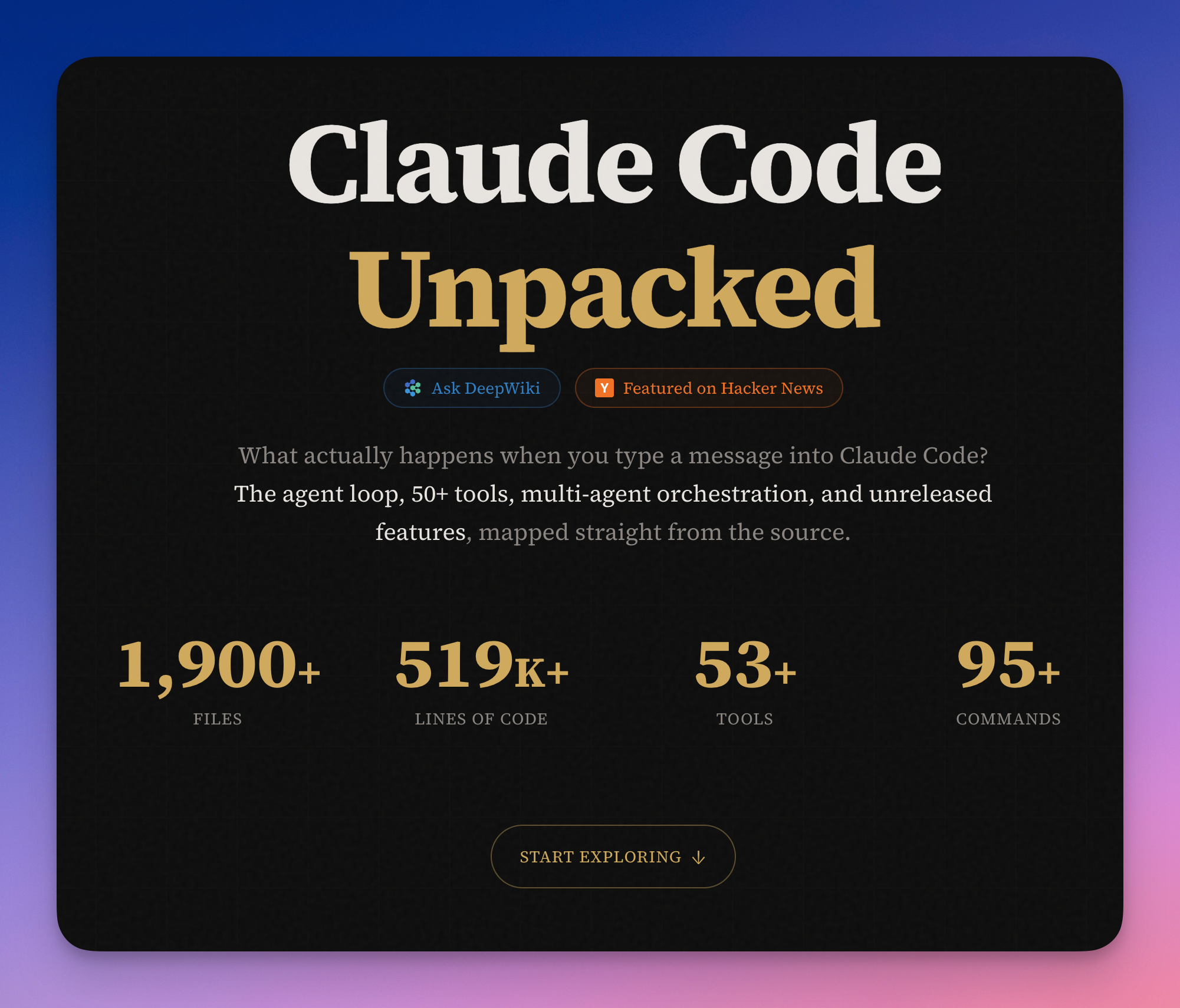
ccunpacked.dev is the cleanest dissection of that leak. It’s an unofficial, community-built site that takes the raw source and turns it into a navigable reference: the agent loop visualized step-by-step, the full tool catalog, every slash command, and a dedicated section on features that are compiled into the binary but gated behind flags set to false in the public build.2
This is not a security disclosure. This is a systems architecture post-mortem - and it’s one of the most instructive reads on production agentic AI design you’ll find anywhere.
How Does Claude Code’s Agent Loop Actually Work?
Think of the master loop like a Walmart self-checkout lane: one item goes in, gets processed, the result either resolves or gets re-queued, and nothing moves forward until that item is done. Simple. Deliberately so.
At the core sits a single-threaded master loop, internally codenamed nO. The pattern is almost embarrassingly minimal: while(tool_call) → execute tool → feed results → repeat. When Claude produces a plain-text response with no tool invocations, the loop terminates and waits. No parallel threads competing for state, no agent swarms thrashing shared memory. 3
The agent loop itself breaks into roughly 11 discrete stages - from input handling and context injection through to streaming output and state reconciliation. Alongside nO runs an async message queue (h2A) that handles real-time steering: you can interrupt, redirect, or cancel mid-execution without blowing up the loop’s state machine. That’s the design bet Anthropic made - debuggability and predictability over raw parallelism. 3
Sub-agents exist, but they’re leashed. Claude can spawn one sub-agent at a time via the dispatch_agent (internally I2A/Task Agent) tool. Those sub-agents cannot spawn their own sub-agents - depth is hard-limited to one level. You get parallelism for codebase-wide searches or multi-approach explorations, but you don’t get recursive agent explosions that are impossible to trace in production.3
What’s in the Tool System? (More Than You Think)
The public docs mention a handful of tools. The source tells a different story. The tool catalog inside ccunpacked.dev maps over 40 built-in tools across seven categories:
| Category | Examples |
|---|---|
| File Operations | read_file, write_file, edit_file, multi_edit |
| Execution | bash, computer |
| Search & Fetch | grep, glob, web_fetch |
| Agents & Tasks | dispatch_agent, task |
| Planning | todo_read, todo_write |
| System Management | mcp (Model Context Protocol) |
| Experimental | web_browser (gated) |
The TODO-based planning tools are particularly interesting. Claude maintains a persistent, in-loop task list - not a scratchpad, but a formal planning artifact that feeds back into its own context. It’s structured autonomy: the model reasons about its own plan as data.2
Each tool invocation also passes through a four-layer decision pipeline before execution. Layers 1–3 are deterministic rule checks. Only when all three are inconclusive does a separate AI classifier fire - always Sonnet, always temperature=0, explicitly scoped as a “safety monitor for autonomous AI programming agents.” The classifier runs against three risk categories: prompt injection, scope creep, and unintended harm. Your CLAUDE.md config gets injected into the classifier’s context, which means your project-level instructions directly influence what the agent is allowed to do autonomously.4
What Are Claude Code’s Hidden Features?
This is the section that broke the internet. The leak documents 44 feature flags gating functionality that is fully compiled but not shipped. These aren’t stubs or TODO comments - they’re real implementation code behind a boolean.1
KAIROS - Always-On Background Agent
KAIROS is a persistent memory and ambient awareness system. It logs user activity across sessions and acts proactively - without waiting for a prompt. Think of it as Claude running in daemon mode, watching your repo for changes and building context continuously. The public build has no session persistence whatsoever; KAIROS is the architectural answer to that gap.5
UltraPlan - 30-Minute Deep Planning
UltraPlan offloads the planning phase of a task to Claude Opus running in a remote cloud container - for up to 30 minutes. You get a browser interface to monitor and approve the plan before execution starts. For migrations, large refactors, or any task where the cost of a wrong plan is measured in hours, this is a qualitatively different capability.5
Coordinator Mode - Multi-Agent Orchestration
One Claude instance acts as an orchestrator managing multiple parallel worker agents through a mailbox system. Each worker gets a restricted toolset and handles a subtask. The coordinator routes work and reconciles results. This is Governed Autonomy in practice - parallelism with explicit coordination topology, not a free-for-all swarm.5
BUDDY - The AI Pet
Yes, really. BUDDY is a virtual pet system with species, traits, and deterministic generation based on your user ID. It was originally planned as an April 1 teaser. It’s absurd, it’s charming, and it’s evidence that Anthropic’s engineers have a sense of humor buried under 512k lines of TypeScript.5
The Rest of the Roadmap
The flag list reads like a product roadmap that forgot to ship:
VOICE_MODE- full voice interaction with its own CLI entrypointWEB_BROWSER_TOOL- real browser control via Playwright, not justweb_fetchDAEMON- background process mode for persistent operationAGENT_TRIGGERS- event-based agent activation (webhooks, cron jobs)DREAM- self-maintaining memory without external storageUNDERCOVER_MODE- prevents Claude from surfacing AI attribution in commits, used internally by Anthropic employees5
What Does This Architecture Tell You About Building Agentic Systems?
Anthropic made a specific, opinionated bet: a single-threaded master loop with one level of sub-agent depth, deterministic tool guards, and explicit planning artifacts beats a multi-agent swarm in production. The debuggability argument is real. When something goes wrong in an unconstrained multi-agent system, your observability stack is doing archaeology. With a flat message history and a single main thread, you can replay every decision.
The four-layer tool permission system is the same principle. Three cheap deterministic checks gate the expensive AI classifier. Your mean time to recovery (MTTR) on a misbehaving agent drops dramatically when the failure modes are enumerated upfront rather than emergent.
The hidden features - KAIROS, Coordinator Mode, AGENT_TRIGGERS - show where the architecture is clearly heading: Sovereign AI workflows that run continuously, not on-demand. Background agents with webhooks and cron schedules. Orchestrators managing worker fleets. This is not speculative. The code is compiled, sitting behind a flag.1
The Real Lesson From the Leak
The architectural decision worth stealing isn’t any single feature. It’s the discipline of controllable autonomy over maximal autonomy. The nO loop, the one-level sub-agent cap, the classifier-as-last-resort - these are deliberate constraints, not limitations. Anthropic built a system where every decision has a traceable path. In an era where “agentic AI” gets conflated with “agent that does whatever it wants,” that constraint is the competitive differentiator.
ccunpacked.dev is worth an afternoon of your time. Not because the leak is salacious - it isn’t - but because it’s a rare, unfiltered look at how a production agentic system actually gets built, warts, virtual pets, and all.2
References
Footnotes
-
https://www.the-ai-corner.com/p/claude-code-source-code-leaked-2026 ↩ ↩2 ↩3
-
https://blog.promptlayer.com/claude-code-behind-the-scenes-of-the-master-agent-loop/ ↩ ↩2 ↩3
-
https://www.gate.com/news/detail/ant-engineer-reverse-engineers-claude-code-source-revealing-the-four-layer-19761177 ↩
-
https://wavespeed.ai/blog/posts/claude-code-leaked-source-hidden-features/ ↩ ↩2 ↩3 ↩4 ↩5